
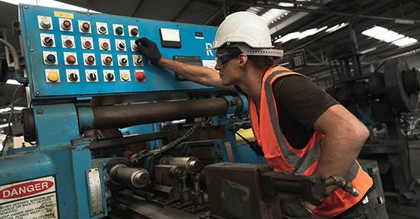
Manufacturing environments present various workplace hazards. Employees typically work with heavy machinery, handle materials, operate forklifts or perform repetitive tasks, all of which can contribute to injuries. Even with strong safety practices in place, accidents can happen — and the resulting workers’ compensation insurance claims can become a significant expense.
This type of coverage is essential for protecting employees and employers, but manufacturers don’t have to accept rising costs. A proactive combination of safety measures, claims management and return-to-work strategies can help control premiums while creating a safer workplace.
Make injury prevention the first priority
One of the most effective ways to manage workers’ comp costs is to prevent injuries in the first place. Begin by identifying the activities and areas of your manufacturing facility that pose the greatest risks. Also, review accident reports, near-miss incidents and previous claims for patterns.
Safety programs should address risks specific to your operations. Depending on the facility, this may include machine guarding, lockout/tagout procedures, personal protective equipment, forklift safety, ergonomics and proper lifting techniques.
Employee involvement can make these efforts more effective. Workers who perform a job every day recognize the hazards and can identify inefficient procedures that aren’t obvious to management. Encourage your employees to report hazards and near misses before they lead to injuries.
Build safety into training and supervision
Safety training shouldn’t be limited to new-hire orientation. Provide periodic refresher training and additional instruction whenever employees take on new responsibilities, equipment or processes.
Supervisors must play a critical role. They should understand and consistently enforce safety procedures rather than allowing employees to take shortcuts to meet production targets. Pay particular attention to newer hires, temporary workers and employees who move into unfamiliar roles. These workers may require additional instruction and supervision until they’re comfortable performing their jobs safely.
Manage claims from the beginning
Even the strongest safety program can’t eliminate every injury. When an accident occurs, how quickly and effectively you respond can substantially affect the eventual workers’ comp impact.
Establish procedures for employees to report injuries promptly and investigate accidents as soon as possible. Early reporting can help injured workers receive appropriate medical attention while allowing management to gather accurate information about what happened.
Stay in communication with injured employees during their recovery and coordinate with your insurer or claims administrator. Maintaining contact can help identify potential problems early and keep claims moving toward resolution.
Develop a return-to-work program
The longer an injured employee remains away from work, the more expensive a claim may become. A formal return-to-work program can help employees resume productive activity as soon as medically appropriate.
Consider whether you can offer temporary modified duties consistent with an employee’s medical restrictions. An injured production worker, for example, might temporarily handle inventory documentation, training or other less physically demanding tasks.
A well-designed program can reduce lost-time costs, preserve employees’ connection to the workplace and make the transition back to their regular duties easier.
Review your insurance program regularly
Don’t assume that your insurer or the workers’ comp process is infallible. Regularly confirm that payroll and employee classifications are accurate. Just as important, double-check your experience modification rate. Used to calculate workers’ comp premiums, this rate — also known as the experience modifier — represents your manufacturing business’s loss history relative to the industry average.
If you have an average loss history, your experience modifier will be 1.0. A higher-than-average loss history raises your modifier above 1.0, increasing your premium; a lower-than-average loss history has the opposite effect. Find out how your insurer determines its modifier and verify that its calculations are accurate. Discuss other loss-control opportunities with your insurance rep as well.
All that said, workers’ comp claims shouldn’t be viewed solely as insurance matters. They can also provide valuable management information. Regularly analyze the frequency, type, severity and cost of claims. Look for trends by department, job function, shift or injury type. The lessons you learn can help refine your approaches to hiring, training, supervision, compensation and benefits.
Turn safety into a financial advantage
Controlling workers’ comp costs takes sustained attention, not a one-time initiative. Preventing injuries, responding quickly when accidents occur and helping employees return to work safely can reduce both the human and financial consequences of workplace injuries.
We can help you track workers’ comp expenses, evaluate their effect on operating costs and identify trends that may warrant management attention. Combined with an effective safety and insurance strategy, these efforts can help protect employees while keeping a significant business expense under control.
© 2026